
A Fresh Air Handling Unit (FAHU) supplies clean outdoor air into a building while filtering dust and pollutants, controlling temperature and humidity, and improving indoor air quality, ventilation, and overall occupant comfort. It plays a vital role in maintaining healthy indoor air quality, proper ventilation, temperature control, and occupant comfort in modern buildings.
Components of FAHU
Casing: The casing is the outer protective enclosure that houses all internal components. It provides structural strength, prevents air leakage, reduces noise, and ensures proper insulation. The casing also protects the unit from dust, moisture, and external damage while supporting efficient and safe airflow operation.
Aluminum Frame: The aluminum frame is the structural support of the casing. It holds all panels and internal components together, ensuring rigidity, durability, and corrosion resistance. It is lightweight yet strong, helping maintain proper alignment, airtight sealing, and long-term performance of the unit.
Base Frame: The base frame supports the entire weight of the system. It provides stability, ensures proper alignment during installation, and allows easy handling and mounting. Manufacturers typically make it from strong, corrosion-resistant materials to withstand load, vibration, and long-term operation.
Cooling & Heating Coils: The cooling and heating coils are responsible for conditioning the incoming fresh air by lowering or raising its temperature as required. Cooling coils remove heat and dehumidify the air, while heating coils warm the air during colder conditions, ensuring a comfortable and controlled indoor environment.
Drain Pan: The drain pan sits beneath the cooling coil and collects and removes condensed water formed during the air cooling and dehumidification process. It prevents water accumulation inside the unit, ensures clean operation, and helps avoid corrosion, leakage, and microbial growth.
Panel: The panel is the insulated enclosure that forms the outer body. It provides thermal and acoustic insulation, protects internal components, and ensures airtight construction for efficient airflow. The panel also helps reduce heat loss, noise levels, and external contamination, improving overall system performance.
Droplet Eliminators: The droplet eliminators are installed after the cooling coil to remove moisture droplets from the air stream. They prevent water carryover into the ducting system, ensuring dry, clean air delivery while protecting downstream components from corrosion and microbial growth.
Handles & Hinges: The handles and hinges are used for easy access to the inspection doors. Hinges allow smooth opening and closing of panels, while handles ensure secure locking. They provide convenient maintenance access while maintaining airtight sealing during operation.
Gasket: The gasket is a sealing material placed between panels, doors, and joints to ensure airtight construction. It prevents air leakage, reduces energy loss, and helps maintain proper pressure and efficient system performance while also minimizing noise and vibration.
Hardware: The hardware includes all fastening elements such as bolts, nuts, screws, and clamps used to assemble and secure different components of the unit. It ensures strong mechanical integrity, stability, and safe operation while allowing proper alignment and easy maintenance.
Filters & Air Purification: A FAHU uses a multi-stage filtration and purification system to ensure clean, safe, and healthy fresh air supply by removing dust, contaminants, odors, and microorganisms.
Types of filters include:
- Pre-filter – removes large dust particles
- Metallic filter – washable coarse filtration
- Soft bag filter – fine dust removal
- Rigid V cell filter – high-efficiency filtration
- HEPA filter – ultra-fine particle removal
- Carbon filter – removes odors and gases
- UV lamps – sterilizes air by killing microbes
Fans: Fans are the driving force of a FAHU system, responsible for moving air through the unit and delivering conditioned fresh air into the building. They ensure proper airflow, pressure balance, and efficient air distribution across all spaces.
Types include:
- Supply fan – delivers fresh, conditioned air to the building
- Exhaust/return fan – removes stale air from indoor spaces
Fans are designed for high efficiency, low noise, and stable performance to support continuous HVAC operation.
Motors: Motors are the power source that drive the fans in a FAHU system, enabling continuous air movement and circulation. They convert electrical energy into mechanical energy to ensure efficient airflow, pressure control, and reliable system performance.
Fan & Motor Assembly: The fan and motor assembly is the driving unit of a FAHU that ensures continuous air movement through the system. The motor powers the fan to supply fresh, conditioned air to the building while maintaining required airflow and pressure.
Pulley & V-Belts: The pulley and V-belts transmit power from the motor to the fan in a FAHU system, enabling smooth and controlled fan operation. They help regulate fan speed and ensure efficient airflow delivery.
Dehumidifying heat pipe: Dehumidifying heat pipes are widely used in AHU/FAHU systems for energy recovery and humidity control. Unlike traditional energy recovery systems that transfer energy between exhaust air and fresh air, a dehumidifying heat pipe recovers energy within the same airstream, improving cooling efficiency and enhancing dehumidification performance.
Heat Recovery Wheel: The heat recovery wheel is an energy-saving component used in a FAHU to transfer heat and moisture between the exhaust air and incoming fresh air without mixing them. It helps improve overall HVAC efficiency by recovering energy from the outgoing air.
Sound Attenuators (SAT): Sound Attenuators (SAT) are used in a FAHU system to reduce noise generated by air movement and fan operation. They help ensure quiet and comfortable indoor environments by minimizing sound transmission through ducting.
Electric Heater (EH): The electric heater heats the incoming fresh air when required, especially during cold conditions, and maintains a comfortable and controlled supply air temperature.
Canopy: The canopy is an external protective cover installed over the FAHU unit, mainly for outdoor applications. It shields the system from rain, dust, sunlight, and other environmental factors, ensuring safe and reliable operation.
Difference Between AHU and FAHU
| AHU (Air Handling Unit) | FAHU (Fresh Air Handling Unit) |
|
|
|
|
|
|
|
|
|
|
Why Fresh Air Handling is Important in Modern Buildings
A FAHU is important in modern buildings because it ensures a continuous supply of fresh, filtered, and conditioned air, which helps maintain healthy indoor air quality and occupant comfort. It reduces indoor pollutants, controls humidity and temperature, and supports proper ventilation in tightly sealed, energy-efficient buildings.
Example: In a hospital, The unit supplies 100% fresh, HEPA-filtered air to operating rooms and patient areas, helping reduce the risk of airborne infections and maintaining a sterile, safe environment for patients and staff.
Which industries require FAHU systems the most?
Fresh air handling systems are most important in industries where high indoor air quality, hygiene, and controlled ventilation are critical. Hospitals and healthcare facilities rely on them to supply clean, filtered air and reduce infection risks. They are also widely used in pharmaceuticals, laboratories, and clean rooms to maintain strict environmental standards. In addition, commercial buildings, airports, hotels, and malls use FAHUs to ensure occupant comfort, proper ventilation, and fresh air supply in high-traffic spaces.
What factors should be considered during system selection?
Several important factors must be considered to ensure proper performance and efficiency during the selection process. These include the required airflow capacity (CFM), fresh air percentage, and the type of application such as hospital, commercial, or industrial use. The filtration level (e.g., HEPA or carbon filters) is also critical, depending on indoor air quality requirements. In addition, factors such as energy efficiency, coil selection (cooling/heating load), available installation space, and noise level requirements should be evaluated to ensure optimal system performance and comfort.
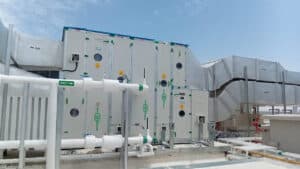
Fresh air handling unit (FAHU) installation image – original site image
About Finpower
Finpower Aircon L.L.C, a part of the Maxell Group, is a leading HVAC equipment manufacturer based in Dubai, UAE. Established in 2012, the company specializes in designing and manufacturing energy-efficient air conditioning and ventilation solutions for commercial, residential, and industrial applications.
Finpower offers a wide range of HVAC products including FAHU, AHU, FCU, heat recovery systems, ventilation units, and custom-built solutions, supported by strong engineering expertise and modern manufacturing facilities.
With a focus on quality, innovation, and energy efficiency, Finpower delivers reliable HVAC systems that improve indoor air quality, reduce energy consumption, and meet international standards, making it a trusted brand across the Middle East and global markets.